When selecting a worksurface, the decision often comes down to two leading materials: engineered stone (KonigZero and KonigQuartz) and ceramic (KonigCeramic). Both deliver exceptional performance and modern design, but they achieve it in very different ways. Understanding these differences helps ensure the right surface is chosen for both lifestyle and aesthetic preference.
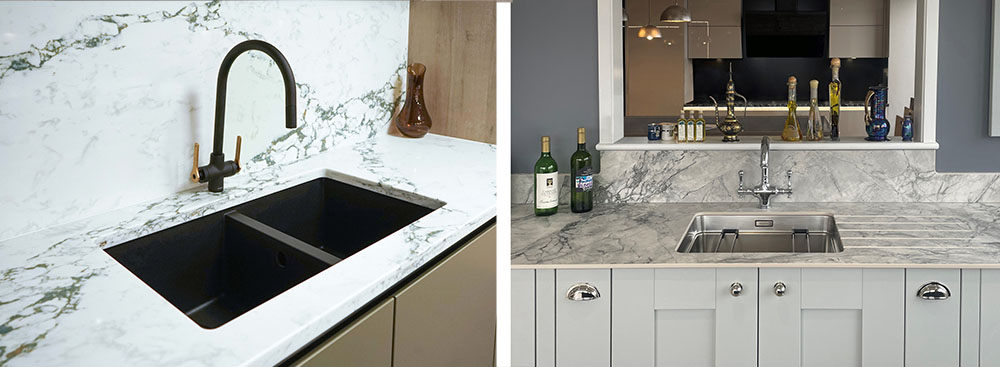
KonigZero Calacatta Verde KonigCeramic Blanco Eclipsia
Appearance
Both engineered stone and ceramic are designed to replicate the beauty of natural materials, offering a wide range of contemporary and classic styles.
KönigQuartz & KönigZero (Engineered Stone)
Engineered stone is full-bodied, meaning the design runs consistently throughout the entire slab. This gives a uniform appearance, particularly important for edge profiles, cut-outs and drainer grooves, where the pattern remains visible and consistent.
KönigCeramic (Sintered Stone)
Ceramic surfaces use advanced printing technology to create highly detailed and realistic designs. This allows for striking veining and intricate finishes that closely mimic natural marble or stone. However, the decoration sits on the surface, meaning the internal core is a solid base colour. As a result, exposed edges and grooves will reveal this core rather than the printed design.
Thickness & Design Possibilities
Material thickness plays an important role in both the overall look and how the surface can be used within a design.
- Engineered Stone: Available in 20mm and 30mm, delivering a substantial, premium feel. It also allows for longer runs with fewer joints, helping to create a seamless, uninterrupted finish across larger areas. A wider variety of edge profiles can also be achieved, from simple pencil rounds to more decorative profiles.
- Ceramic: Available in 12mm and 20mm, making it ideal for slim, contemporary designs. Its lighter weight and reduced thickness mean it is particularly well suited to furniture cladding, including cabinetry doors, panels, and feature elements—allowing a fully coordinated, uniform kitchen aesthetic.
Heat Resistance
This is one of the most significant performance differences between the materials.
- Engineered Stone: Contains natural minerals combined with resin. While highly durable, under extreme heat it can be susceptible to thermal shock. The use of trivets or pan supports is recommended.
- Ceramic: Manufactured using extremely high temperatures, making it inherently heat resistant. Hot pans can be placed directly onto the surface without risk of damage.
Stain Resistance
Both materials perform exceptionally well in everyday kitchen environments.
- Engineered Stone: Non-porous and highly resistant to stains from common household items such as wine, coffee, and oils.
- Ceramic: Also non-porous and resistant to staining, with excellent resistance to chemicals and cleaning agents.
In practical terms, both surfaces are well suited to busy family kitchens.
Maintenance
Ease of maintenance is a key consideration for modern living.
- Engineered Stone: Requires minimal maintenance—simply clean with warm soapy water and a soft cloth. No sealing is required.
- Ceramic: Equally low maintenance and highly hygienic. Its dense, non-porous surface resists bacteria and is easy to wipe clean.
Both surfaces are designed for convenience, supporting effortless day-to-day care. Due to the subtle micro-unevenness present in the surface, more stubborn marks may occasionally require a little additional attention to fully remove.
Chip & Impact Resistance
All hard surfaces can be damaged under certain conditions, particularly from heavy impacts or sharp blows.
- Engineered Stone: Contains resin, which gives it a small degree of flexibility, making it slightly more forgiving under impact.
- Ceramic: Extremely hard and dense, offering excellent scratch resistance, but with less flexibility, meaning it can be more brittle if struck at a sharp angle.
In everyday use, both materials are more than capable of withstanding the demands of a busy kitchen when handled with reasonable care.
Price & Fabrication
Cost and manufacturing processes are also important considerations when comparing materials.
- Engineered Stone: Typically more cost-effective and benefits from well-established fabrication methods. Its versatility allows for efficient production, making it a strong all-round choice for many projects.
- Ceramic: Generally positioned at a higher price point. This reflects not only the material itself but also the specialist fabrication techniques required. Ceramic requires advanced cutting and handling processes, contributing to increased manufacturing complexity and cost.
Material Safety
With the safe fabrication of stone worktops increasingly featured in industry discussions, many customers are now considering more responsible material choices.
- KonigZero Engineered Stone: A silica-free worktop that delivers the same aesthetic appeal and performance characteristics associated with traditional high-silica quartz, while supporting safer fabrication practices.
- Ceramic: Contains approximately 15–20% crystalline silica, making it a low-silica surface option compared to conventional Quartz materials.
Choosing surfaces with reduced or zero silica content can offer additional peace of mind, particularly when considering the full lifecycle of the product—from manufacture through to installation—while still achieving a high-end, design-led finish.
Making the Right Choice
Königstone engineered stone and Ceramic surfaces offer outstanding quality, durability and design.
- Choose KönigQuartz or KönigZero for:
- A full-bodied appearance with consistent pattern throughout
- Longer runs with fewer visible joints
- A wider range of edge profile options
- Slightly greater flexibility under impact
- A more cost-effective solution
- Choose KönigCeramic for:
- Ultra-realistic printed designs and contemporary finishes
- Slim, modern surface profiles
- Superior heat resistance
- The ability to clad cabinetry and create a fully uniform look
- High-performance, design-led applications
Final Thought
Both materials ultimately provide high-performing, durable surface solutions well suited to modern living. The final choice often comes down to aesthetic preference and practical considerations, such as whether you want to place hot pans directly from the oven onto the surface. Whichever you choose, both options are designed to deliver lasting beauty and everyday practicality.